

Proven to make a meaningful difference.
Leva is backed by published clinical studies demonstrating significant improvement in bladder and bowel leakage symptoms, sustained results and high engagement with treatment.
From randomized controlled trials (RCTs) to real-world studies, the evidence shows what can happen when pelvic floor muscle training (PFMT) is guided—not guessed.
The evidence, at a glance.
Highlights from Leva's pivotal trial and real-world evidence studies
80%
Fewer bladder leaks1
In the pivotal RCT, women reported significant reduction in stress-related bladder leakage episodes (on a 3-day bladder diary).
2 years
Sustained urinary symptom improvement2
In long-term follow up from the pivotal RCT, symptom improvement after the initial Leva treatment program persisted through 24 months.
74%
Achieved urinary symptom improvement3
In a real-world study of 947 women, nearly 3 in 4 achieved meaningful or acceptable improvement in urinary symptoms.
60%
Achieved meaningful bowel symptom improvement4
In a real-world study of 214 women, over half achieved clinically meaningful improvement in fecal incontinence symptoms after 8 weeks.
PIVOTAL RANDOMIZED CONTROLLED TRIAL
Leva-guided pelvic floor muscle training (PFMT) outperformed standard home PFMT.1
Pelvic floor muscle training is recommended as first-line care—but without supervision, patients may have difficulty performing exercises correctly and consistently.
In an 8-week randomized controlled trial, Leva-guided PFMT produced significantly greater improvement in urinary incontinence symptoms than a standard home PFMT program using written and narrated instructions.
80% fewer SUI episodes after 8 weeks
Daily stress urinary incontinence (SUI) episodes
Baseline and 8-week outcomes for Leva-guided PFMT compared with standard home PFMT.
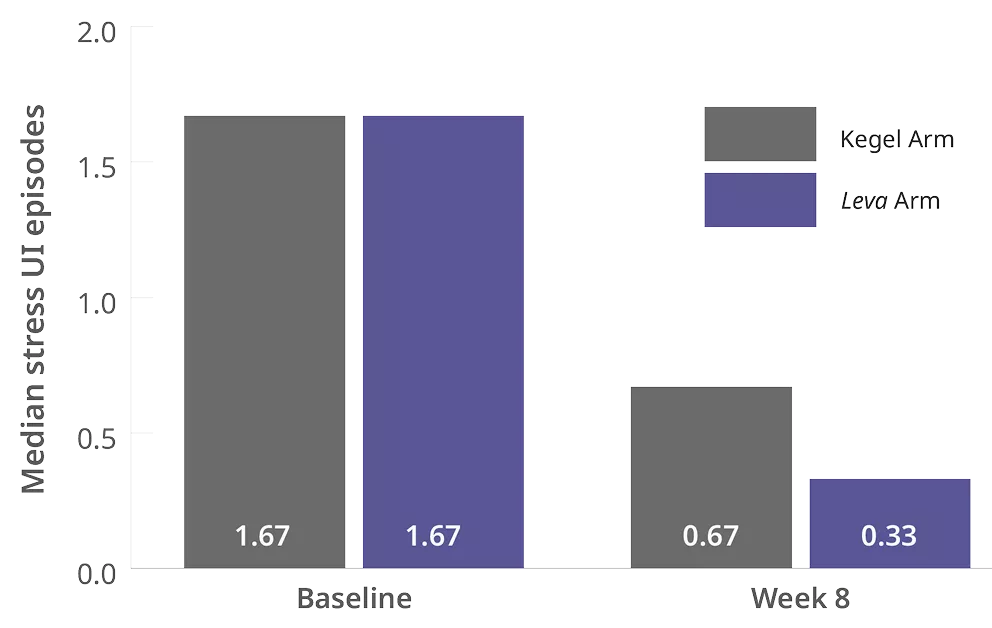
Median SUI episodes recorded over 3 days decreased from 5 to 1 with Leva-guided PFMT, compared with 5 to 2 with standard home PFMT (P=.005)
Women using Leva reported greater symptom improvement
Leva-guided PFMT vs standard home PFMT
NEARLY
2x
the odds of reporting improvement
OR 1.94
95% CI, 1.21–3.15
At 8 weeks, women using Leva had nearly twice the odds of reporting their symptoms were “much better” or “very much better” compared with home PFMT
Clinical validation
These improvements were also reflected in a validated clinical measure of urinary symptoms (Urogenital Distress Inventory: UDI-6). Average UDI-6 scores improved by 18.8 points with Leva compared with 14.7 points with the standard home PFMT program.
View pivotal study details
Study
Digital Therapeutic Device for Urinary Incontinence: A Randomized Controlled Trial
Design
Prospective, 8-week, remotely conducted randomized controlled superiority trial
Population
Women with stress or stress-predominant mixed urinary incontinence
Randomization/Analysis
363 women randomized; 299 included in the 8-week analysis:
- 143 to Leva-guided PFMT
- 156 to standard home PFMT
Treatment period
8 weeks
Primary outcomes
Change in UDI-6 score and change in stress urinary incontinence episodes recorded in a 3-day bladder diary
Key findings
- UDI-6: 18.8-point improvement with Leva vs 14.7 with control; P=.01
- SUI episodes: median decreased from 5 to 1 with Leva vs 5 to 2 with control; P=.005
- PGI-I: nearly twice the odds of reporting symptoms “much better” or “very much better” with Leva
- OR 1.94 (95% CI, 1.21–3.15)
Study limitation
The trial evaluated women with stress or stress-predominant mixed urinary incontinence; findings should not automatically be generalized to other pelvic floor conditions or patient populations
LONG-TERM FOLLOW-UP
Improvements lasted well beyond the Leva treatment period.2,3
Pelvic floor muscle training (PFMT) is intended to produce benefits that extend beyond the active treatment period. Longitudinal follow-up of the pivotal trial evaluated whether improvements with Leva were sustained after the initial 8-week program.
Women from the pivotal randomized trial were followed for up to 24 months after the initial 8-week treatment period. Urinary symptom improvement with Leva remained significantly greater than with standard home PFMT.
Urinary symptom improvement was sustained through 24 months.
UDI-6 symptom scores through 24 months
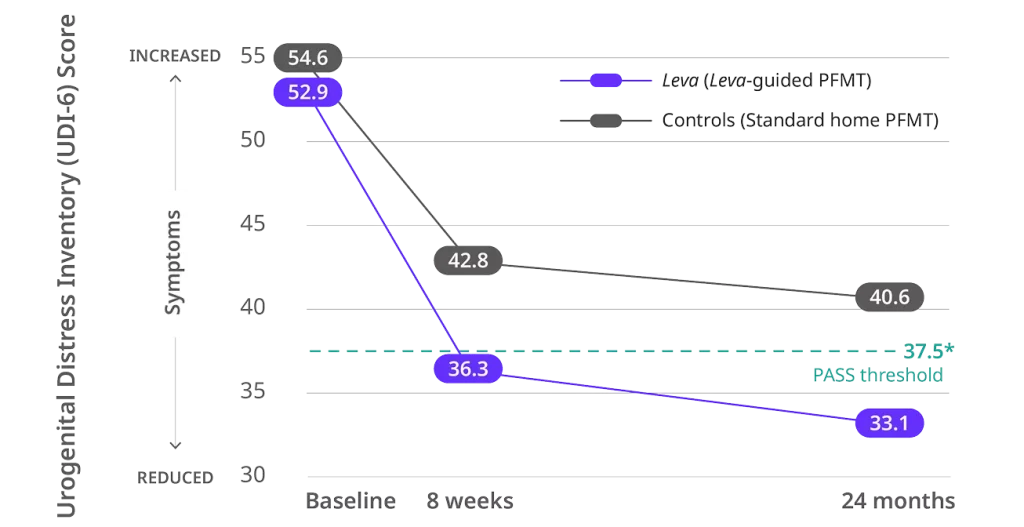
At 24 months, Leva users maintained clinically meaningful improvement in urinary symptoms and remained below the Patient Acceptable Symptom State (PASS) threshold.4
Results remained significant two years later.
21.1
points
UDI-6 improvement with the Leva PFMT Group
14.7
points
with standard PFMT program
At 24 months, Leva users continued to demonstrate significantly greater symptom improvement on validated patient-reported measures.
View long-term study details
STUDIES
Digital Therapeutic Device for Urinary Incontinence: A Longitudinal Analysis at 6 and 12 Months (2023)2
A Motion-based Device Urinary Incontinence Treatment: A Longitudinal Analysis at 18 and 24 Months (2024)3
Design
Longitudinal follow-up of participants from the original randomized controlled trial of Leva-guided PFMT versus standard home PFMT
Study population
Participants from the original randomized controlled trial with stress or stress-predominant mixed urinary incontinence
Follow-up periods
Of the 299 participants analyzed at 8 weeks, 286 (96%) provided 6- and 12-month data and 231 (77%) provided 18- and 24-month data
TREATMENT AFTER 8 WEEKS
Participants were not asked to continue treatment after the initial 8-week program, and most did not continue using Leva
24-Month UDI-6 Outcome
- Leva-guided PFMT: 21.1-point improvement
- Standard home PFMT: 14.7-point improvement
- P=.04
24-MONTH PATIENT-REPORTED IMPROVEMENT
At 24 months, participants assigned to Leva had nearly twice the odds of reporting symptom improvement compared with standard home PFMT (OR 1.95; 95% CI, 1.08–3.57)
Durability without continued use
On average, Leva users maintained or exceeded the UDI-6 Minimum Important Difference at 24 months and remained below the Patient Acceptable Symptom State (PASS) threshold of 37.55
Study Context
These results represent longitudinal follow-up of the original randomized study population, rather than a new randomized treatment period. A sensitivity analysis found no difference between participants who provided 24-month data and those who did not
REAL-WORLD RESULTS
Clinical trial results translated into real life.
Will women use Leva—and experience meaningful improvement—outside a traditional clinical trial?
A peer-reviewed study evaluated 947 women who used Leva as prescribed in everyday practice.
Nearly 3 in 4 women achieved urinary symptom improvement.6

achieved ≥1 predefined threshold for clinical improvement
58.4% met UDI-6 Minimum Important Difference
60.6% met the PASS threshold score
Leva users showed significant improvement across age, BMI, and UI subtype categories.6
Symptom improvement on the Urogenital Distress Inventory (UDI-6) from baseline to follow-up
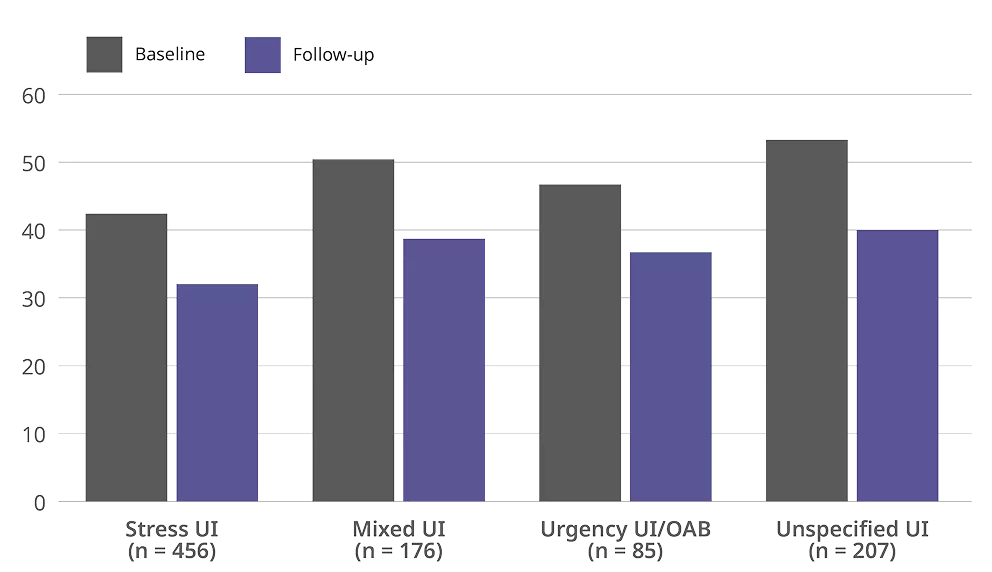
Overall mean UDI-6 scores improved by 11.3 points from baseline to follow-up (P<.001).
Improvement in UDI-6 scores was observed across users, regardless of age, BMI, and UI sub-type, and symptom improvement was similar across these categories.
View real-world study details
Study
Real-World Evidence From a Digital Health Treatment Program for Female Urinary Incontinence: Observational Study of Outcomes Following User-Centered Product Design
Design
Retrospective observational cohort study of commercial Leva users
Population
947 women with urinary incontinence who completed baseline and at least one follow-up UDI-6 assessment. The cohort included women with stress, urgency and mixed UI
STUDY period
Commercial user data collected from January 1, 2022 through June 30, 2023
effectiveness ASSESSMENTS
UDI-6 Minimum Important Difference (MID), UDI-6 Patient Acceptable Symptom State (PASS), and Patient Global Impression of Improvement (PGI-I)
Key findings
- Mean UDI-6 improvement: 11.3 points; P<.001
- 74% achieved a predefined measure of symptom improvement
- 58.4% achieved the UDI-6 minimum clinically important difference
- 60.6% reached the UDI-6 Patient Acceptable Symptom State
- Of 651 PGI-I responses, 77% reported symptom improvement
- Improvement was observed across age, BMI and urinary-incontinence subtype
Interpretive caution
This was a single-arm observational study without a control group. Results reflect real-world use patterns but do not establish comparative efficacy
FECAL INCONTINENCE
Randomized and real-world evidence support Leva for chronic fecal incontinence.
Leva is indicated for the first-line treatment of chronic fecal incontinence in women (>3-month uncontrolled passage of feces). Two 2026 publications provide complementary evidence: a randomized trial evaluating treatment duration and outcomes, and a real-world study evaluating outcomes during routine commercial use.
Both randomized and real-world evidence demonstrated meaningful improvement by 8 weeks.
RANDOMIZED EQUIVALENCE TRIAL
8 weeks
was equivalent to 16 weeks for improvement in FI severity7
-4.7
POINTS
8 weeks
-4.8
POINTS
16 weeks
BOTH REACHED THE MCID
P=.918
Improvement sustained through 24 weeks after treatment.
REAL-WORLD EVIDENCE
73%
reported global symptom improvement4
-8.2
POINTS
mean CRADI-8 improvement at 8 weeks
P<.0001
58.4%
achieved CRADI-8 MCID
Real-world study: n=214
View fecal-incontinence study details
STUDY A
RANDOMIZED TRIAL
Patel UJ, Keyser LE, Gontarczyk Uczkowski N, Giles DL, Brown HW. Home-Based Biofeedback for Fecal Incontinence: A Randomized Clinical Trial. Urogynecology (Phila). 2026;32(4):464-473. doi:10.1097/SPV.0000000000001810
Design
Randomized, investigator-blinded equivalence trial comparing 8 weeks versus 16 weeks of home-based, biofeedback-guided pelvic floor muscle training
Analyzed population
38 women with chronic fecal incontinence were randomized; 36 provided complete data
Treatment period
Leva twice daily for 8 or 16 weeks
Primary outcomes
- Change in Vaizey/St. Mark’s Incontinence Score at 16 weeks
Key findings
- 8 weeks was equivalent to 16 weeks for improvement in FI severity
- Vaizey/St. Mark’s score change: −4.7 vs −4.8 points; P=.918
- Both groups reached the Minimum Clinically Important Difference (MCID)
- Improvement was sustained through 24 weeks after treatment completion
- Pelvic floor muscle strength and endurance improved significantly
- Mean adherence was 75.2%
- No device-related serious adverse events were reported
Study limitation
This trial compared two treatment durations rather than comparing Leva with a non-Leva control group
STUDY B
REAL-WORLD EVIDENCE
Keyser LE, Mueller JL, Hosterman LM, McKinney JL, Pulliam SJ, Bordeianou L. A Digital Therapeutic Pelvic Health System Improves Fecal Incontinence Symptoms in a Real-World Patient Cohort. Dis Colon Rectum. 2026;69(6):1712–1721. doi:10.1097/DCR.0000000000004195
Design
Observational cohort study using de-identified commercial user data from women using Leva in the United States
Analyzed population
214 women with FI met inclusion criteria: 200 identified through self-reported FI symptoms and 14 through clinical diagnosis
Treatment period
8 weeks, baseline to follow-up
Primary outcomes
- Change in CRADI-8 score from baseline to 8 weeks
- Patient-reported global symptom improvement (PGI-I)
Key findings
- Mean CRADI-8 score change: −8.2 points (P<.0001)
- 58.4% achieved the CRADI-8 MCID
- 73% reported global symptom improvement
- Pelvic floor muscle excursion and contraction hold time improved significantly
- Weekly treatment adherence remained high
- No device-related serious adverse events were reported
Study limitation
Observational real-world study without a control group; FI symptom identification relied predominantly on patient self-report
WHY GUIDANCE MATTERS
Pelvic floor training works best when women can do it correctly- and keep doing it.
Traditional instructions may tell a woman which exercises to perform, but they cannot show her what her pelvic floor is doing during each contraction.
Leva uses motion sensors and an app to provide visual feedback while the woman exercises. The program also tracks progress and can provide added support through the Leva Women's Center and clinician reporting.

Know you're doing it correctly
Real-time feedback displays the lift-and-squeeze movement produced by the pelvic floor muscles during training.

See your progress
The app records performance and helps women follow the prescribed program over time.

Fit treatment into daily life
Each guided session takes approximately 2½ minutes, twice a day, and can be completed at home.
Why this matters
In the 947 real-world study, women who used the system at least 10 times per week were more likely to achieve meaningful symptom improvement. The evidence does not prove that the technology alone caused adherence, but it shows a clear relationship between consistent use and better outcomes.
SAFETY AND TOLERABILITY
Leva provides prescription incontinence treatment without medication or surgery.
IN CLINICAL TRIALS AND REAL-WORLD USE:
No serious device-related adverse events were reported.
As with any prescription treatment, Leva is not right for everyone. Women should review the Important Safety Information and talk with a healthcare professional about their individual circumstances.
Explore the Leva evidence
Browse key published findings from randomized, long-term and real-world studies assessing the effectiveness of Leva-guided pelvic floor muscle training.
Randomized controlled trial
Device-guided versus standard home pelvic floor muscle training.
8-week randomized trial evaluating urinary symptoms, leakage episodes, quality of life and patient-reported improvement.
Long-term follow-up
Outcomes through 24 months
Longitudinal follow-up evaluating whether improvements following the original course of therapy persisted over time.
Real-world evidence
Outcomes and engagement among 947 users
Observational evidence evaluating symptom improvement, program use and factors associated with clinically meaningful results.
Randomized equivalence trial
Home-based biofeedback for fecal incontinence
Randomized trial comparing 8 versus 16 weeks of Leva-guided treatment for chronic fecal incontinence.
Real-world evidence
Outcomes among 214 women with fecal incontinence
Observational evidence evaluating symptom improvement and engagement among women using Leva for fecal incontinence in routine practice.
Additional peer-reviewed publications
View additional publications (5)
• Keyser LE, McKinney JL, Pulliam SJ, Weinstein MM. A digital health program for treatment of urinary incontinence: retrospective review of real-world user data. Int Urogynecol J. 2023;34(5):1083-1089.
• Weinstein MM, Collins S, Quiroz L, et al. Multicenter Randomized Controlled Trial of Pelvic Floor Muscle Training with a Motion-based Digital Therapeutic Device versus Pelvic Floor Muscle Training Alone for Treatment of Stress-predominant Urinary Incontinence. Female Pelvic Med Reconstr Surg. 2022;28(1):1-6.
• Weinstein MM, Pulliam SJ, Richter HE. Randomized trial comparing efficacy of pelvic floor muscle training with a digital therapeutic motion-based device to standard pelvic floor exercises for treatment of stress urinary incontinence (SUV trial): An all-virtual trial design. Contemp Clin Trials. 2021;105:106406.
• Weinstein MM, Dunivan GC, Guaderrama NM, Richter HE. Impact of a Digital Therapeutic Device on Pelvic Floor Symptoms. Urogynecology (Phila). Published online March 17, 2025. doi:10.1097/SPV.0000000000001674
• Bohorquez J, McKinney J, Keyser L, Sutherland R, Pulliam SJ. Development of a wireless accelerometer-based Intravaginal device to detect pelvic floor motion for evaluation of pelvic floor dysfunction. Biomed Microdevices. 2020;22(2):26. Published 2020 Mar 17. doi:10.1007/s10544-020-00479-3
Citations
View all citations (7)
1. Weinstein MM, Dunivan G, Guaderrama NM, Richter HE. Digital Therapeutic Device for Urinary Incontinence. Obstetrics & Gynecology. 2022;Publish Ah(00):1-10. doi:10.1097/aog.0000000000004725
2. Weinstein MM, Dunivan GC, Guaderrama NM, Richter HE. Digital Therapeutic Device for Urinary Incontinence: A Longitudinal Analysis at 6 and 12 Months. Obstetrics & Gynecology. 2023;141(1):199-206. doi:10.1097/AOG.0000000000005036.
3. Weinstein MM, Dunivan GC, Guaderrama NM, Richter HE. A Motion-based Device Urinary Incontinence Treatment: A Longitudinal Analysis at 18 and 24 Months. International Urogynecology Journal. 2024;35(4):803-810. doi:10.1007/s00192-023-05721-z.
4. Keyser LE, Mueller JL, Hosterman LM, McKinney JL, Pulliam SJ, Bordeianou L. A Digital Therapeutic Pelvic Health System Improves Fecal Incontinence Symptoms in a Real-World Patient Cohort. Dis Colon Rectum. 2026;69(6):1712-1721. doi:10.1097/DCR.0000000000004195
5. Sanderson DJ, Zavez A, Meekins AR, et al. The Patient Acceptable Symptom State in Female Urinary Incontinence. Female Pelvic Med Reconstr Surg. 2022;28(1):33-39. doi:10.1097/SPV.0000000000001055
6. Hall E, Keyser L, McKinney J, Pulliam S, Weinstein M. Real-World Evidence From a Digital Health Treatment Program for Female Urinary Incontinence: Observational Study of Outcomes Following User-Centered Product Design. JMIR Form Res. 2024;8:e58551. doi:10.2196/58551
7. Patel UJ, Keyser LE, Gontarczyk Uczkowski N, Giles DL, Brown HW. Home-Based Biofeedback for Fecal Incontinence: A Randomized Clinical Trial. Urogynecology. 2026;32(4):464-473. doi:10.1097/SPV.0000000000001810