

Evidence-based care with the potential to lower total cost.
Leva® combines prescription, home-based pelvic floor muscle training (PFMT) with real-time motion-based visual feedback, patient support, and progress monitoring.
Published clinical studies demonstrate meaningful symptom improvement, while peer-reviewed health economic modeling projects lower medical spending when Leva is incorporated into the urinary incontinence care pathway.

FDA-Cleared Prescription Therapy

Clinical Evidence in UI & FI

Published Randomized & Real-World Evidence

Peer-Reviewed Health Economic Evidence
Important Indication and Other Information for the Leva® Pelvic Health System
The Leva® Pelvic Health System is intended for (1) strengthening of pelvic floor muscles, (2) rehabilitation and training of weak pelvic floor muscles for the treatment of stress, mixed, and mild to moderate urgency urinary incontinence (including overactive bladder) in women and (3) rehabilitation and training of weak pelvic floor muscles for the first-line treatment of chronic fecal incontinence (>3-month uncontrolled passage of feces) in women. This device interacts with the user via smartphone technology. Treatment with the Leva System is by prescription and is not for everyone. Please talk to your prescriber to see if Leva System is right for you. Your prescriber should discuss all potential benefits and risks with you. Do not use the Leva System while pregnant, or if you think you may be pregnant, unless authorized by your doctor. For complete risk information and instructions, review the current Leva Pelvic Health System Instructions for Use.
Pharmacy Code
60002099440
HCPCS Code
S9002
Evidence-based pelvic floor muscle training is recommended—but access remains limited.
Pelvic floor muscle training is an established treatment for urinary and fecal incontinence, yet many women face barriers to accessing structured, supervised care. Leva provides guided PFMT at home, combining real-time, motion-based visual feedback with patient support and clinician reporting.
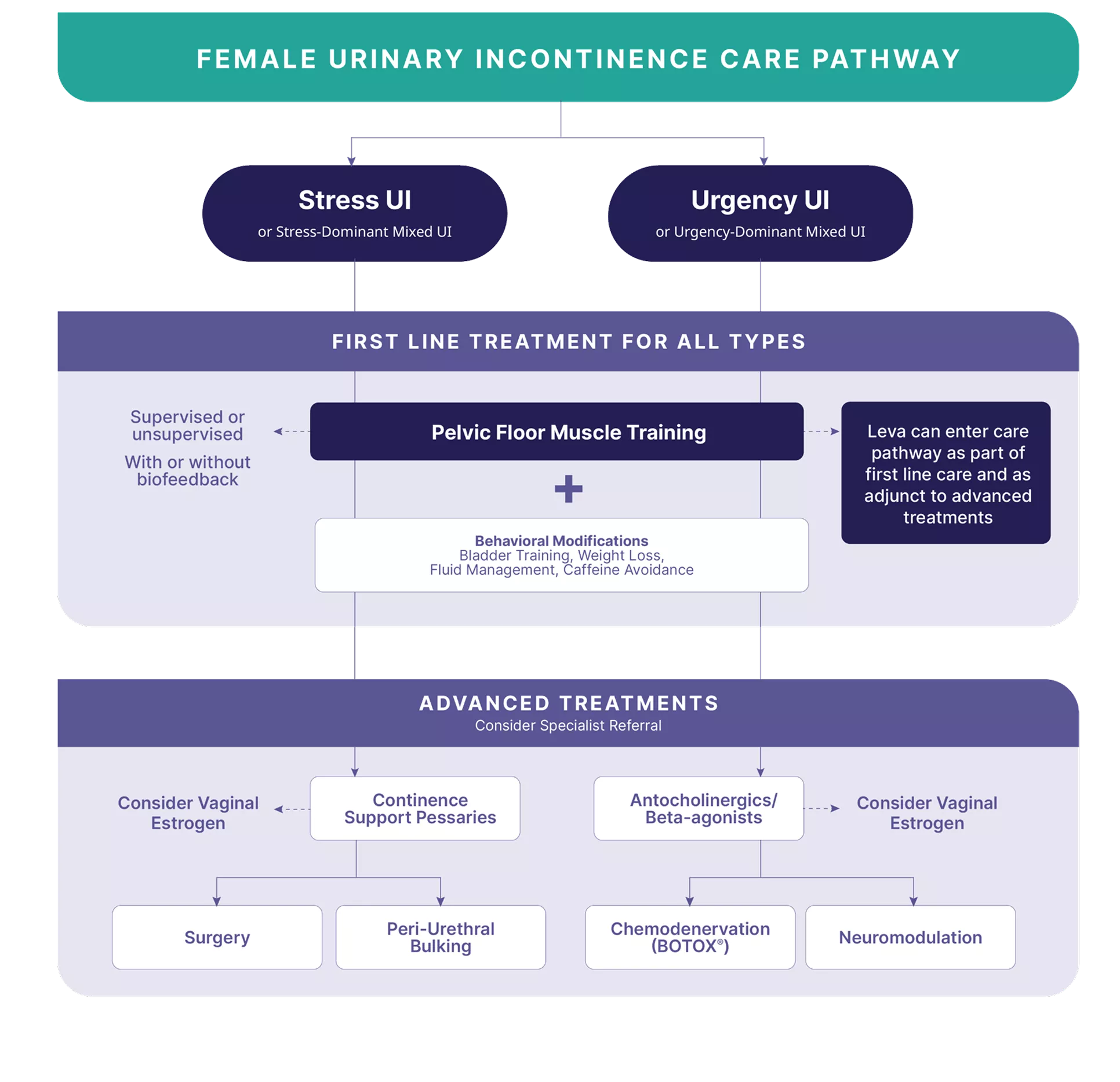
- Urinary Incontinence in Women. Practice Bulletin No. 155. American College of Obstetricians and Gynecologists. Obstet Gynecol 2015; 126:e66–81.
- Kobashi KC, Albo ME, Roger R, et al. Surgical treatment of female stress urinary incontinence: AUA/SUFU guideline. J Urol. 2017 Oct;198(4):875–883.
- Qaseem A, Dallas P, Forciea MA, Starkey M, Denberg TD. Clinical Guideline Nonsurgical Management of Urinary Incontinence in Women: A Clinical Practice Guideline From the American College of Physicians. 2014; (September 2013). doi:10.7326/M13-2410.
- Hu JS, Pierre EF. Urinary Incontinence in Women: Evaluation and Management. Am Fam Physician. 2019;100(6):339–348.
- Society of Urodynamics, Female Pelvic Medicine, Urogenital Reconstruction Foundation (SUFU). Overactive Bladder Clinical Care Pathway. https://sufuorg.com/docs/sufu-oab-flyer.aspx. Accessed 25 Sep 2020.
Proven in clinical trials—and confirmed in real-world practice.
Published randomized and real-world studies support the safety and effectiveness of Leva for women with urinary and fecal incontinence.
Urinary Incontinence
80%
Reduction in leakage episodes after only 8 weeks
From a published randomized controlled trial.1

Urinary Incontinence
24 months
Sustained symptom improvement
Lasting symptom improvement through two years of follow-up.2

Urinary Incontinence
74%
Achieved clinically meaningful improvement
From a 947-patient real-world study.3
Fecal Incontinence
Randomized and Real-World Evidence
Randomized and real-world studies demonstrated clinically meaningful improvement in fecal incontinence symptoms, with improvement in pelvic floor muscle performance and high treatment engagement.4,5
Urinary incontinence carries a meaningful cost burden.
In a large U.S. claims analysis, women with stress or mixed urinary incontinence had significantly greater healthcare utilization and higher medical costs than matched women without UI. Over two years, mean total medical costs were 61% higher among women with SUI/MUI.⁶
A peer-reviewed model projects lower health plan costs with Leva.
A 2025 peer-reviewed budget impact analysis evaluated the projected economic impact of incorporating Leva into the urinary incontinence treatment pathway for a hypothetical one-million-member U.S. commercial health plan. The model compared current clinical practice with a scenario in which 15% of women receiving treatment for UI received Leva.
Projected commercial health plan savings7
>$25.7M
Projected health plan savings over 24 months
$1.07 PMPM
Projected average savings per member per month
$820
Projected lower estimated 24-month cost per treated patient
The model projected lower utilization of higher-cost advanced treatments when Leva was incorporated into the treatment pathway. Actual costs and savings may vary by health plan.
Interested in evaluating Leva for your members?
Contact Axena Health to discuss clinical evidence, health economic data and coverage considerations.
Citations
View all citations (7)
1. Weinstein MM, Dunivan G, Guaderrama NM, Richter HE. Digital Therapeutic Device for Urinary Incontinence: A Randomized Controlled Trial. Obstet Gynecol. 2022;139(4):606–615. doi:10.1097/AOG.0000000000004725.
2. Weinstein MM, Dunivan GC, Guaderrama NM, Richter HE. A Motion-based Device Urinary Incontinence Treatment: A Longitudinal Analysis at 18 and 24 Months. Int Urogynecol J. 2024. doi:10.1007/s00192-023-05721-z.
3. Hall E, Keyser L, McKinney J, Pulliam S, Weinstein M. Real-World Evidence From a Digital Health Treatment Program for Female Urinary Incontinence: Observational Study of Outcomes Following User-Centered Product Design. JMIR Formative Research. 2024;8:e58551. doi:10.2196/58551.
4. Patel UJ, Keyser LE, Gontarczyk Uczkowski N, Giles DL, Brown HW. Home-Based Biofeedback for Fecal Incontinence: A Randomized Clinical Trial. Urogynecology (Phila). 2026;32(4):464-473. doi:10.1097/SPV.0000000000001810.
5. Keyser LE, Mueller JL, Hosterman LM, McKinney JL, Pulliam SJ, Bordeianou L. A Digital Therapeutic Pelvic Health System Improves Fecal Incontinence Symptoms in a Real-World Patient Cohort. Dis Colon Rectum. 2026;69(6):1712–1721. doi:10.1097/DCR.0000000000004195.
6. Datar M, Pan LC, McKinney JL, Goss TF, Pulliam SJ. Healthcare Resource Use and Cost Burden of Urinary Incontinence to United States Payers. Neurourol Urodyn. 2022;1-10. doi:10.1002/nau.24989.
7. Hall E, Sharma A, Goss TF, Hung K. U.S. payer budget impact of the Leva Pelvic Health System to improve pelvic floor muscle training as first-line treatment of female urinary incontinence compared to real-world clinical practice. J Med Econ. 2025;28(1):637–647. doi:10.1080/13696998.2025.2494940.